NobleProg delivers expert-led Deep Learning training courses across Nepal, empowering professionals and organizations with the latest industry skills. Leveraging our extensive presence in the Indian subcontinent, we provide accessible and high-quality learning solutions tailored to the local market. Participants gain valuable insights through interactive sessions designed to enhance career growth and organizational performance.
Delivered either online or on-premises, these instructor-led live Deep Learning (DL) training programs offer hands-on experience to master the core principles and practical applications of the field. Key topics explored include deep machine learning, deep structured learning, and hierarchical learning.
Training options are available as "online live" or "onsite live" sessions. Online live training (also referred to as "remote live training") is facilitated through an interactive, remote desktop. Onsite live training can be conducted directly at your local facilities in Nepal or at NobleProg’s corporate training centers in Nepal.
NobleProg -- Your Local Training Provider
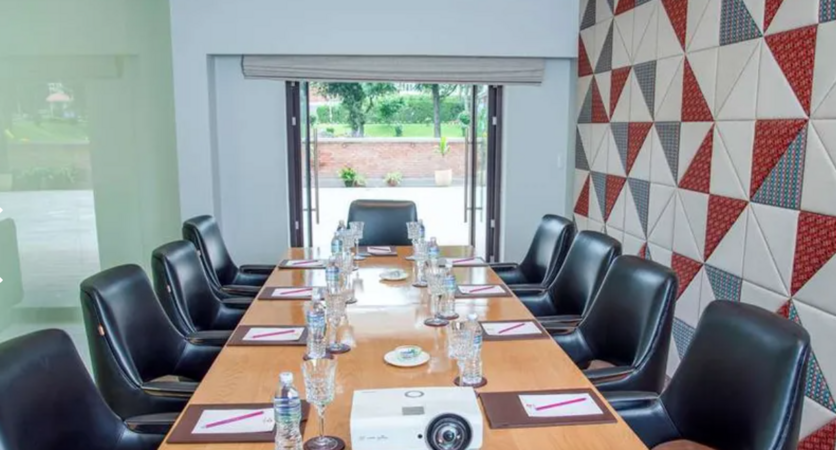
Nepal, Kathmandu - Classroom
near Soaltee, Tahachal Marg, Kathmandu, Nepal, 44600
Set in Kathmandu, this classroom is well located near Tahachal Marg with all amenities and WiFi.
For Sales Enquires and Meetings
All our centres have batches running on weekdays and weekends hence, please note that, in most cases, usually we are not able to organise ad hoc sales meetings, especially on our classrooms as they are all occupied with ongoing training sessions . Please contact us by e-mail or phone at least one day earlier to make an appointment with one of our consultants at our corporate offices.
Nepal, Thamel, KTM - Classroom
near Radisson , Ward 2, Kathmandu, Nepal, 44600
Set in Kathmandu, this classroom is well located near Thamel, with all amenities and WiFi.
For Sales Enquires and Meetings
All our centres have batches running on weekdays and weekends hence, please note that, in most cases, usually we are not able to organise ad hoc sales meetings, especially on our classrooms as they are all occupied with ongoing training sessions . Please contact us by e-mail or phone at least one day earlier to make an appointment with one of our consultants at our corporate offices.
This instructor-led, live training in Nepal (online or onsite) is aimed at intermediate-level developers, data scientists, and AI practitioners who wish to leverage TensorFlow Lite for Edge AI applications.
By the end of this training, participants will be able to:
Understand the fundamentals of TensorFlow Lite and its role in Edge AI.
Develop and optimize AI models using TensorFlow Lite.
Deploy TensorFlow Lite models on various edge devices.
Utilize tools and techniques for model conversion and optimization.
Implement practical Edge AI applications using TensorFlow Lite.
This instructor-led, live training in Nepal (online or onsite) is aimed at advanced-level professionals who wish to deepen their understanding of computer vision and explore TensorFlow's capabilities for developing sophisticated vision models using Google Colab.
By the end of this training, participants will be able to:
Build and train convolutional neural networks (CNNs) using TensorFlow.
Leverage Google Colab for scalable and efficient cloud-based model development.
Implement image preprocessing techniques for computer vision tasks.
Deploy computer vision models for real-world applications.
Use transfer learning to enhance the performance of CNN models.
Visualize and interpret the results of image classification models.
This instructor-led live training, conducted in Nepal (either online or onsite), targets intermediate-level data scientists and developers who aim to understand and apply deep learning techniques using the Google Colab environment.
By the end of this training, participants will be able to:
Set up and navigate Google Colab for deep learning projects.
Understand the fundamentals of neural networks.
Implement deep learning models using TensorFlow.
Train and evaluate deep learning models.
Utilize advanced features of TensorFlow for deep learning.
This instructor-led, live training in Nepal (online or onsite) is designed for advanced professionals aiming to specialize in cutting-edge deep learning techniques for NLU.
By the conclusion of this training, participants will be able to:
Understand the fundamental differences between NLU and NLP models.
Apply advanced deep learning techniques to NLU tasks.
Explore deep architectures such as transformers and attention mechanisms.
Leverage future trends in NLU for building sophisticated AI systems.
This instructor-led, live training in Nepal (online or onsite) targets advanced-level professionals who wish to explore state-of-the-art XAI techniques for deep learning models, with a focus on building interpretable AI systems.
By the end of this training, participants will be able to:
Understand the challenges of explainability in deep learning.
Implement advanced XAI techniques for neural networks.
Interpret decisions made by deep learning models.
Evaluate the trade-offs between performance and transparency.
This instructor-led, live training in Nepal (online or onsite) is targeted at intermediate to advanced-level data scientists, machine learning engineers, deep learning researchers, and computer vision experts who wish to deepen their knowledge and skills in deep learning for text-to-image generation.
By the conclusion of this training, participants will be able to:
Comprehend advanced deep learning architectures and techniques for text-to-image synthesis.
Implement complex models and optimizations for generating high-quality images.
Optimize performance and scalability for large datasets and complex models.
Tune hyperparameters to enhance model performance and generalization.
Integrate Stable Diffusion with other deep learning frameworks and tools.
This instructor-led, live training in Nepal (online or onsite) caters to advanced professionals aiming to leverage AI to revolutionize drug discovery and development.
By the end of this course, participants will be able to:
Comprehend the role of AI in drug discovery and development.
Apply machine learning techniques to predict molecular properties and interactions.
Use deep learning models for virtual screening and lead optimization.
Integrate AI-driven approaches into the clinical trial process.
This instructor-led, live training in Nepal (online or onsite) is aimed at biologists who wish to understand how AlphaFold works and use AlphaFold models as guides in their experimental studies.
By the end of this training, participants will be able to:
Understand the basic principles of AlphaFold.
Learn how AlphaFold works.
Learn how to interpret AlphaFold predictions and results.
This instructor-led, live training in Nepal (online or onsite) is aimed at beginner-level to intermediate-level developers who wish to use Large Language Models for various natural language tasks.
By the end of this training, participants will be able to:
Set up a development environment that includes a popular LLM.
Create a basic LLM and fine-tune it on a custom dataset.
Use LLMs for different natural language tasks such as text summarization, question answering, text generation, and more.
Debug and evaluate LLMs using tools such as TensorBoard, PyTorch Lightning, and Hugging Face Datasets.
This instructor-led, live training (online or onsite) is aimed at data scientists, machine learning engineers, and computer vision researchers who wish to leverage Stable Diffusion to generate high-quality images for a variety of use cases.
By the end of this training, participants will be able to:
Understand the principles of Stable Diffusion and how it works for image generation.
Build and train Stable Diffusion models for image generation tasks.
Apply Stable Diffusion to various image generation scenarios, such as inpainting, outpainting, and image-to-image translation.
Optimize the performance and stability of Stable Diffusion models.
In this instructor-led, live training session in Nepal, participants will explore the most relevant and cutting-edge machine learning techniques in Python. Through the development of a series of demonstration applications involving image, music, text, and financial data, learners will gain practical insights.
Upon completion of this training, participants will be able to:
Implement machine learning algorithms and techniques to address complex challenges.
Apply deep learning and semi-supervised learning methods to applications involving image, music, text, and financial data.
Maximize the potential of Python algorithms.
Leverage libraries and packages such as NumPy and Theano.
This hands-on training in Nepal enables programmers to build AI models from scratch using Python. Participants will gain proficiency in supervised learning, neural networks, and unsupervised techniques by working with scikit-learn and Apache Spark. The course emphasizes practical Jupyter exercises aimed at solving real-world problems.
This instructor-led training in Nepal explores the theoretical underpinnings and practical application of Deep Reinforcement Learning using Python. Participants will develop and train DRL agents with TensorFlow or PyTorch, leveraging key algorithms like DQN and PPO to solve complex real-world challenges.
An introductory course on Nepal covering the fundamentals of AI, ranging from intelligent agents to machine learning. It prepares executives and architects to evaluate emerging AI trends, integrate practical solutions, and enhance business agility through automated strategies.
Discover how Machine Learning and Deep Learning are reshaping the automotive landscape. This Nepal course explores fundamental concepts ranging from straightforward automation to autonomous decision-making, covering neural networks and providing practical TensorFlow examples for real-world implementation.
This three-day program on Nepal explores both the theoretical underpinnings and practical applications of Artificial Neural Networks, Machine Learning, and Deep Learning. Participants will delve into network architectures, learning mechanisms, and mathematical foundations, progressing from fundamental perceptrons to advanced deep learning methodologies.
This instructor-led, live training in Nepal (online or onsite) provides an introduction into the field of pattern recognition and machine learning. It touches on practical applications in statistics, computer science, signal processing, computer vision, data mining, and bioinformatics.
By the end of this training, participants will be able to:
Apply core statistical methods to pattern recognition.
Use key models like neural networks and kernel methods for data analysis.
Implement advanced techniques for complex problem-solving.
Improve prediction accuracy by combining different models.
This instructor-led, live training in Nepal (online or onsite) targets software developers, data analysts, and technical professionals who want to use TensorFlow 2.x and Keras to build, train, and deploy deep learning models for computer vision, natural language processing, and multimodal applications.
This instructor-led live training in Nepal (online or onsite) is designed for data scientists who wish to use TensorFlow to analyse potential fraud data.
By the end of this training, participants will be able to:
Create a fraud detection model in Python and TensorFlow.
Build linear regressions and linear regression models to predict fraud.
Develop an end-to-end AI application for analysing fraud data.
In this instructor-led, live training, participants will learn how to use MATLAB to design, build, and visualize a convolutional neural network for image recognition.
By the end of this training, participants will be able to:
Build a deep learning model
Automate data labeling
Work with models from Caffe and TensorFlow-Keras
Train data using multiple GPUs, the cloud, or clusters
Audience
Developers
Engineers
Domain experts
Format of the course
Part lecture, part discussion, exercises and heavy hands-on practice
This instructor-led live training in Nepal (online or onsite) targets developers and data scientists aiming to utilize Tensorflow 2.x for building predictors, classifiers, generative models, neural networks, and similar applications.
By the end of this training, participants will be able to:
Install and configure TensorFlow 2.x.
Understand the benefits of TensorFlow 2.x over previous versions.
Build deep learning models.
Implement an advanced image classifier.
Deploy a deep learning model to the cloud, mobile and IoT devices.
This 35-hour programme on Nepal delves into the fundamentals of deep neural networks, covering CNNs, RNNs, and generative models such as GANs. Learners gain practical experience with Theano and TensorFlow, mastering the construction, training, and deployment of production-grade deep learning models for real-world scenarios.
Read more...
Last Updated:
Testimonials (5)
Getting people that never used AI some repetition in prompting and people that do use AI to consider different methods to using it.
Matthew Gay - Tarsus Pharmaceuticals
Course - Artificial Intelligence (AI) Overview
The training was organized and well-planned out, and I come out of it with systematized knowledge and a good look at topics we looked at
Magdalena - Samsung Electronics Polska Sp. z o.o.
Course - Deep Learning with TensorFlow 2
Working from first principles in a focused way, and moving to applying case studies within the same day
Maggie Webb - Department of Jobs, Regions, and Precincts
Course - Artificial Neural Networks, Machine Learning, Deep Thinking
That it was applying real company data.
Trainer had a very good approach by making trainees participate and compete
Jimena Esquivel - Zaklad Uslugowy Hakoman Andrzej Cybulski
Course - Applied AI from Scratch in Python
In-depth coverage of machine learning topics, particularly neural networks. Demystified a lot of the topic.
Online Deep Learning (DL) training in Nepal, Deep Learning training courses in Nepal, Weekend Deep Learning (DL) courses in Nepal, Evening Deep Learning training in Nepal, Deep Learning instructor-led in Nepal, DL (Deep Learning) on-site in Nepal, Deep Learning (DL) boot camp in Nepal, DL (Deep Learning) coaching in Nepal, Deep Learning (DL) trainer in Nepal, Deep Learning (DL) instructor in Nepal, DL (Deep Learning) classes in Nepal, Online Deep Learning training in Nepal, Deep Learning instructor-led in Nepal, Deep Learning one on one training in Nepal, Deep Learning (DL) private courses in Nepal, Evening Deep Learning courses in Nepal, Weekend Deep Learning (DL) training in Nepal